AI for Good
“AI for Good” is an educational and creative hackathon focused on the ethical and conscious use of Artificial Intelligence to generate positive social impact. Aimed at upper secondary school students, the event invites participants to design digital solutions that can reduce inequalities, improve access to education and promote well-being.
The challenges proposed include:
- Identify common emotional or social challenges faced by teenagers (e.g., stress, loneliness, bullying, uncertainty about the future).
- Imagine how an AI-based system could support them, for example through guided reflections, community stories or motivational resources, and present this vision through a mockup, storyboard or prototype narrative.
- Reflect on ethical implications, including privacy, data protection, empathy and boundaries of AI use in education.
The programme includes training sessions on AI, digital ethics, design thinking and prototyping, followed by teamwork with ongoing mentorship. The hackathon concludes with a presentation to a jury of experts in technology, education and social inclusion.
The address to attend this onsite hackathon is: Via Francesco Maria Alias 20, Palermo
Questions?
jaqueline.rinaldi@ceipes.org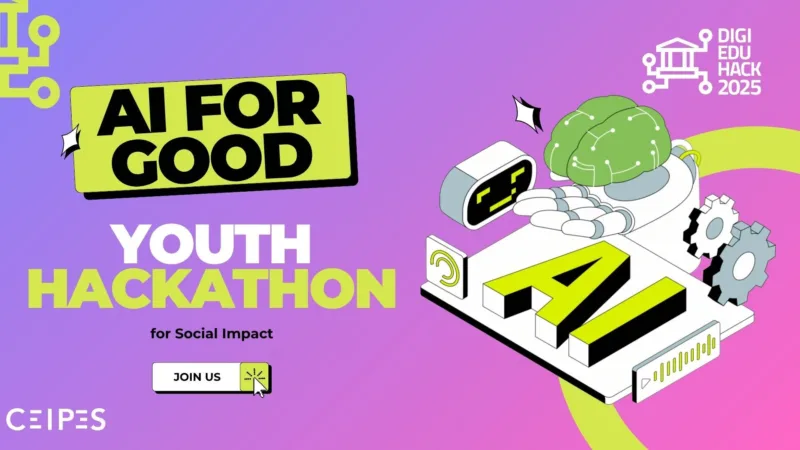
Who can join?
Specific conditions to apply
- Age: 14-18 years old.
- Registration open to secondary school students.
- Group participation.
- One computer will be provided for each team, but we suggest that you bring another computer from your team.
07 - 11 NOV 2025
Register by 06 NOVLanguage(s) of the hackathon
Italiano
Onsite
Palermo - Italy
Well-being in Digital Education
Challenge and goals
- Educate young people about the potential and risks of artificial intelligence.
- Stimulate critical thinking and the ability to design ethical and sustainable solutions.
- Promote inclusion, equal opportunities and active citizenship in line with EU objectives.
- Provide practical skills in design, prototyping and communication.
- Create AI projects with social impact
- Develop transferable skills: teamwork, time management, problem solving, public speaking.
- Expected results: at least one concept per team, documented and presented to the jury.
Expectations and requirements for the solutions and participants
- Participation in all phases of the hackathon (24 hours spread over three days).
- Work in teams of 3-5 people with complementary roles (design, research, coding, communication).
- Willingness to learn digital tools and basic AI concepts.
- No programming skills required.
- Final presentation in Italian or English.
Available Support
- Mentorship from experts in AI, education, and social inclusion.
- Workshops on AI, design thinking, prototyping and well-being in education.
- Ongoing technical assistance during the development phases.
Schedule
-
07/11/2025 9:00 18:00
Welcome, Inspiration & Team Building
Friday, 7 November | 9:00 – 18:00
The first day will focus on welcoming participants and introducing them to the spirit of the DigiEduHack.
After the welcome session and the presentation of the CEIPES team, students will attend an introduction to what an hackathon is, what the DigiEduHack initiative represents, and what goals this European program pursues in promoting digital innovation and sustainability in education.
The morning will continue with icebreaker activities designed to build trust and collaboration among participants. The central moment of the day will be the presentation of the main challenge: “AI for Good – Artificial Intelligence for Social Impact”, which invites students to design creative, inclusive solutions to support well-being and learning.
Participants will then share their ideas and form multidisciplinary teams, learning how to combine different skills and perspectives.
After lunch and a short energising physical activity, students will join Workshop 1 – Design Thinking, led by Samuele Morvillo, to learn how to turn an idea into a human-centred project that responds to real needs.
In the afternoon, teams will begin developing their first project drafts under the guidance of mentors, before ending the day with a collective reflection and daily wrap-up.
-
10/11/2025 9:00 18:00
Prototyping, Training & Well-being
Monday, 10 November | 9:00 – 18:00
The second day will focus on project development and personal growth.
After a short welcome back session, participants will take part in Workshop 2 – Mental Well-being, led by Federica (SCU), which explores mental health, stress management and empathetic collaboration within teams.
Following a short break, students will continue to work on their projects with the support of CEIPES mentors, focusing on concept development and prototype creation.
In the afternoon, after lunch and a creative group activity, participants will attend Workshop 3 – Responsible Use of Artificial Intelligence, led by Roberto Restivo. This session will introduce the ethical and practical aspects of AI and show how to use accessible tools—such as chatbots or AI assistants—to build simple prototypes.
The day will close with a project development checkpoint, where each team will briefly present its progress and receive targeted feedback from mentors. A peer review session will follow, allowing groups to exchange constructive feedback and improve their ideas collaboratively.
-
11/11/2025 9:00 18:00
Presentation, Evaluation & Celebration
Tuesday, 11 November | 9:00 – 18:00
The final day will be dedicated to the presentation of projects and the award ceremony.
The morning will begin with a brief recap and final preparation time for teams to polish their presentations and finalise their pitch materials.
By midday, all projects will be officially submitted. After the lunch break, the event will move to the public presentation phase: each team will have 5–7 minutes to present their project and answer questions from the jury.
While the jury deliberates, evaluating projects based on social impact, creativity, ethics, and clarity of communication, participants will enjoy a relaxing and fun activity to unwind before the final results.
After a short break, the Awarding Ceremony will take place, announcing the winning teams and recognising their innovative contributions.
The event will conclude with a final wrap-up session, where students and mentors will reflect together on the experience, followed by a group photo and informal networking moment to celebrate the end of the hackathon.
Mentors

Agnese Doro

Stefania Bertolazzi

Oguzcan Kirkar

Domenica La Greca
Judges

Sara Vivirito

Mariella Xavier