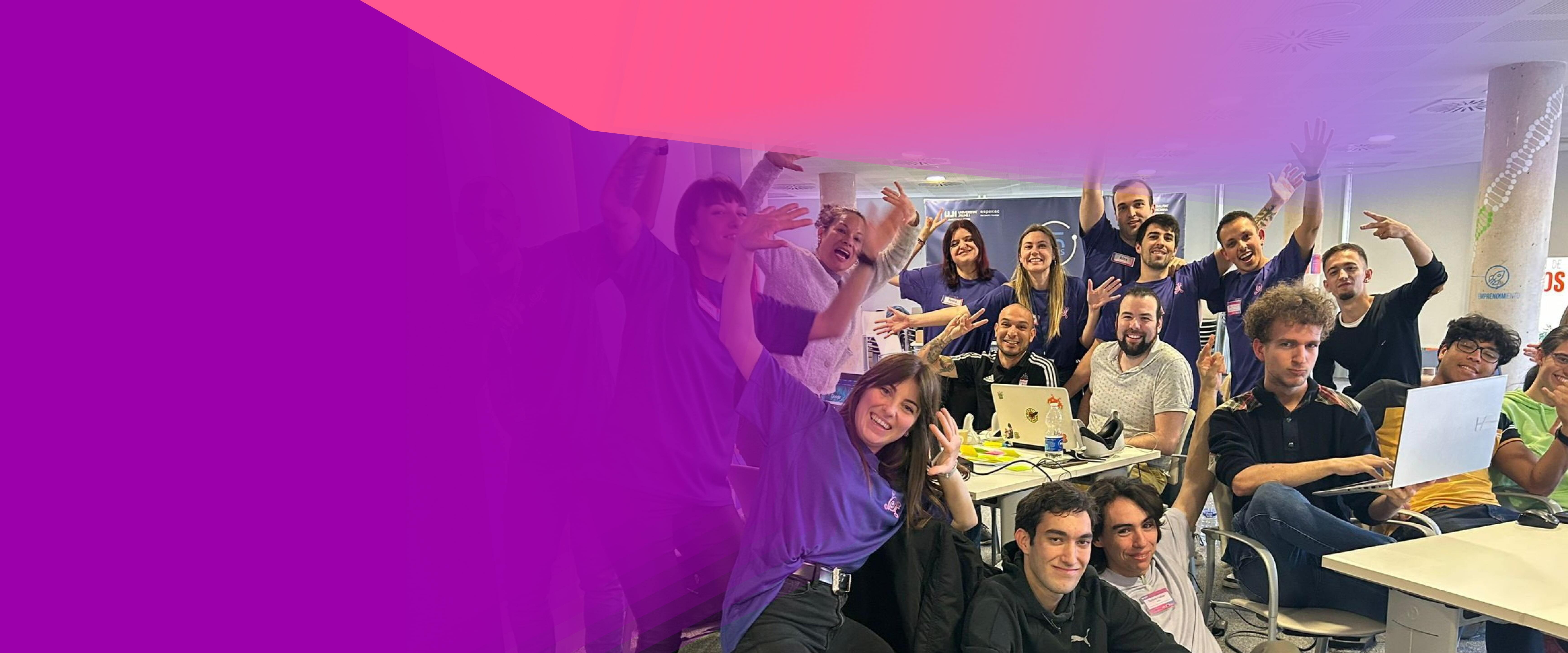
LOCAL WINNER
Finalists for Beginner Awards: Social impact and Disruptive technology
EduBridge: Empathetic AI mentor for migrant youth education
Solution details
EduBridge is an intelligent and empathetic AI mentor designed to support migrant adolescents (12–20 years old) who face educational setbacks after relocation.
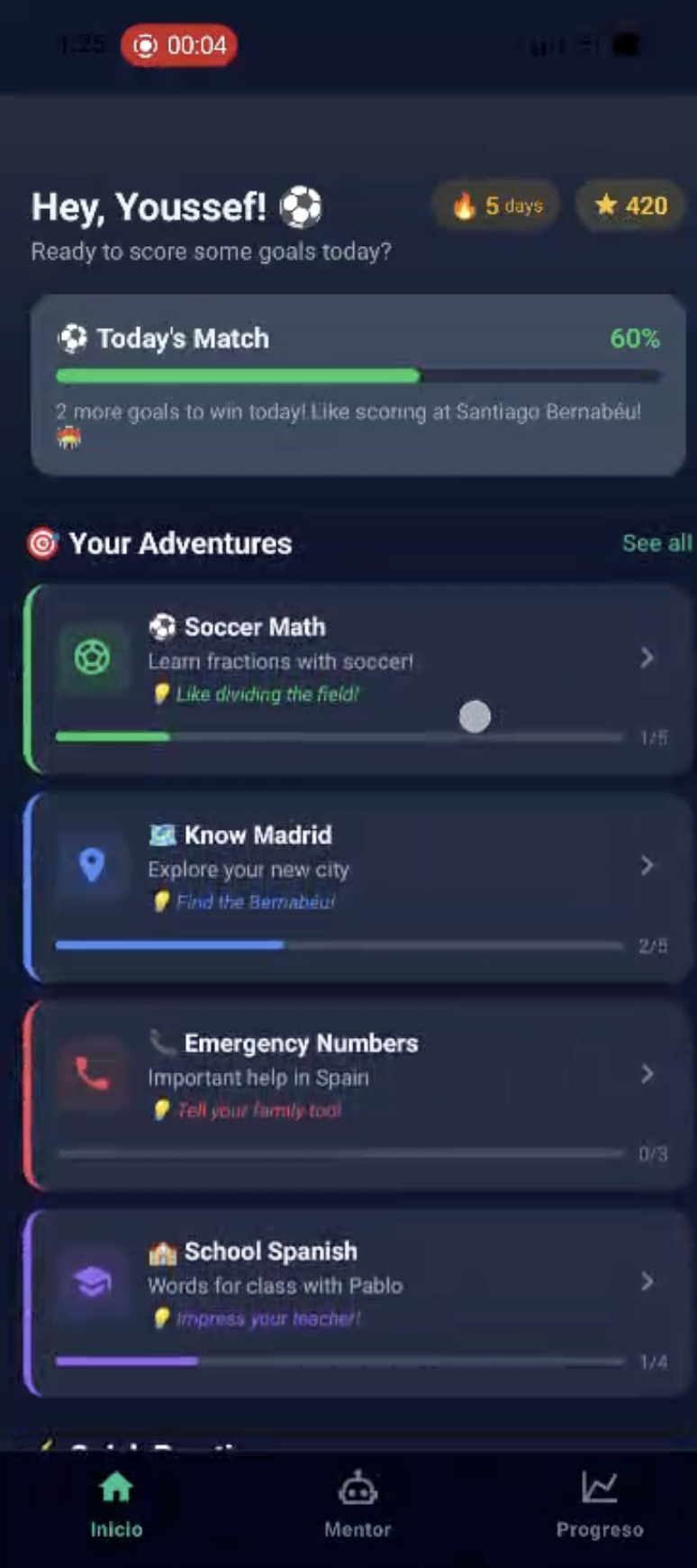
The system uses conversational AI to understand each student’s background, interests, fears, and dreams, creating a personalized learning profile.
It builds a “skill tree” that merges their personal interests (sports, music, pop culture) with academic STEM objectives, while also offering social and cultural integration modules, such as learning the local language, understanding civic norms, and navigating essential services.
EduBridge transforms education into a meaningful, adaptive, and human-centered experience.
Tweet / Slogan
EduBridge is an empathetic AI mentor that personalizes education for migrant youth, blending their interests with STEM learning while teaching culture, language, and belonging, bridging the gap between displacement and opportunity.

Resources
Resources include:
- UML-App architecture
- Prototype complete functionality
- Complete investigation
Context
Europe faces a critical educational challenge: 4.5 million migrant youth aged 12–20 are navigating school systems that were not designed for students experiencing disrupted education, language gaps and cultural displacement. In Spain, migrant dropout reaches 35% (over double the native rate) and repetition exceeds 50%, reflecting more than a full year of academic lag (Mahía & Medina, 2022). Across Europe, dropout among migrant youth is 2–3× higher, and the consequences are systemic: each early leaver represents €70,000–€100,000 in lost lifetime productivity and increased social costs (OECD, 2020). The challenge is both humanitarian and economic: Europe cannot afford to allow so many young people to disengage. EduBridge addresses this crisis by uniting adaptive AI, personalized STEM learning and culturally grounded onboarding, aligning perfectly with DigiEduHack’s mission to create inclusive, future ready digital education ecosystems.
Who Benefits?
EduBridge primarily supports migrant youth aged 12–20, who face the highest risk of academic lag, isolation and dropout. In Spain alone, 530,000–560,000 students fall within this group, and their educational trajectories are threatened by linguistic barriers, interrupted schooling and cultural disorientation. EduBridge benefits them by offering personalized STEM lessons linked to their interests, emotional onboarding through storytelling, and RAG powered cultural guidance that teaches essential daily life skills (transportation, healthcare, public services, social norms). This empowers learners academically and socially, increasing confidence and independence.
Governments, schools and educators benefit through reduced dropout, better classroom engagement and improved integration outcomes. Governments and NGOs gain a scalable, cost-effective solution that transforms investment into measurable savings by preventing long term social exclusion. EduBridge thus supports learners, institutions and societies simultaneously.
Impact
EduBridge delivers educational, social, and economic impact. It increases academic engagement by teaching STEM through each student’s interests and adapting difficulty to their profile. Socially, it supports faster adaptation by offering practical, country specific guidance on transport, healthcare, emergency systems, and daily communication, reducing anxiety and strengthening belonging. Economically, lowering migrant dropout by 20% could save Spain €7 billion in ten years, with governments recovering €80–€140 per €1 invested (OECD, 2020). Impact is tracked through dropout reduction, STEM progress, engagement metrics, cultural adaptation indicators, and projected public savings. EduBridge improves individual outcomes while reinforcing social cohesion and long term economic stability.
Team work
Juan Rodrigo Ferro, Computer Science Engineer, brings expertise in C++, full-stack development, and scalable system architecture.
Mario Gaitán and Luis Alan, Data Science Engineering students, specialize in statistical analysis, machine learning, and data pipelines.
Uriel Crespo, Robotic Engineering student, contributes prototyping, hardware–software integration, and UX testing.
Fernando Aguirre, Data Engineering student with finance training, leads statistical modeling, ROI analysis, and strategic planning.
Together, we form a multidisciplinary team with strong technical depth, understanding of educational challenges in Europe, and a shared commitment to ethical AI and social impact. We aim to continue working as a unified group to expand EduBridge internationally.
Board of advisors
Jan Rehak. National Director at Tecnológico de Monterrey
Cesar Sánchez. Directive at the Institute for the Future of Education (IFE)
Gabriel Charles Cavazos. Regional Director at Tecnológico de Monterrey.
Nathaly Pinzón Rubio. Associate Director at Tecnológico de Monterrey.
Innovativeness
EduBridge is innovative because it integrates learning, cultural adaptation and emotional support into one cohesive AI mentor, something no current tool offers. LMS platforms provide standardized content without personalization; translation apps support communication but lack academic depth; and NGO programs offer human help but cannot scale to millions. EduBridge merges these needs through adaptive AI, narrative based profiling and a personalized Skill Tree that teaches STEM through each learner’s interests.
Its RAG engine ensures cultural guidance is accurate, local and always up to date, covering emergency services, school expectations, transportation and real social contexts. This ability to deliver academically relevant, emotionally supportive and culturally grounded guidance simultaneously makes EduBridge genuinely original. It is not a tutoring app, not a chatbot, and not a cultural guide; it is a new form of socio-educational technology designed specifically for migrant youth.
Transferability
EduBridge is highly transferable due to its modular, data driven architecture. The Skill Tree can be adapted for different curricula, languages and age groups, while the RAG system allows each region to upload its own verified datasets such as emergency numbers, public service rules, cultural norms and transportation systems. By simply changing the underlying content, EduBridge can support international students, refugees, vocational trainees, adult newcomers or EU funded digital upskilling programs.
The same platform could guide university exchange students in Germany, assist refugees resettling in Italy or help adults learning workplace digital skills in France. Its approach to interest-based learning, cultural onboarding and adaptive support applies across educational and non formal training environments. EduBridge’s flexibility ensures it can scale beyond migrant education and become a core tool within broader European integration and lifelong learning initiatives.
Sustainability
EduBridge’s sustainability model begins with early-stage support from international NGOs (UNICEF, UNHCR, Save the Children and the Bill & Melinda Gates Foundation) whose missions align with education, youth protection and migration support. Their funding and legal oversight ensure ethical design and early deployment with vulnerable groups. After successful pilots in Spain, EduBridge transitions to partnerships with ministries of education, enabling national scaling and integration into digital learning infrastructures.
Mid-term sustainability comes from NGO backed grants and state approved educational ADS focused on public-service messages (health, scholarships, youth programs), ensuring non-commercial funding that protects minors’ data. Long-term sustainability arises from EduBridge’s strong investment–benefit logic: reducing dropout and improving integration yields significant national savings up to €80–€140 returned per €1 invested (OECD, 2020). EduBridge evolves with policy needs, ensuring platform longevity and relevance across future educational and demographic shifts.