LOCAL WINNER
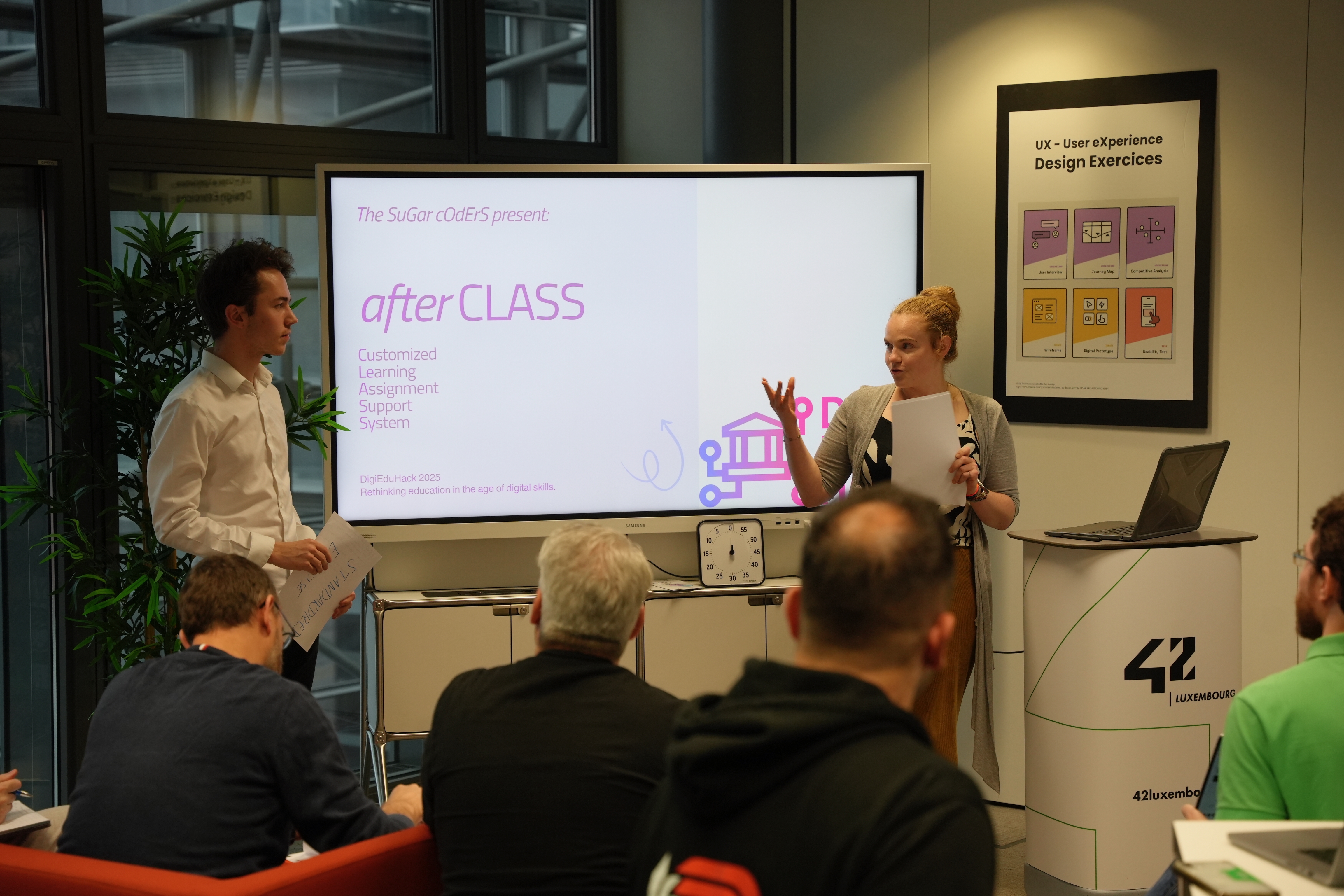
afterCLASS (Customized Learning Assignment Support System)
Solution details
Two-sided, teacher-student digital learning platform for secondary education with an AI-powered, adaptive homework and self-study challenge generation system that creates personalized learning activities based on teacher defined learning objectives.
Tweet / Slogan
Say goodbye to one-size-fits-all homework! Our platform uses AI to create adaptive, multilingual assignments based on class materials and student needs. Teachers get insights, students get support, everyone learns better.

The SuGar cOdErS
Resources
See the platform prototype: https://heat-shelf-51475244.figma.site
Presentation and solution canvas can be found in the resource files.
Context
Students increasingly rely on external AI tools for homework support, but teachers have little visibility into the accuracy, relevance, or pedagogical alignment of these interactions. Meanwhile, classrooms are more diverse than ever with different languages, learning preferences, attention spans, and prior knowledge levels.
With that said, teachers have limited time and resources to provide personalized guidance to every student. This can lead to widening learning gaps, inconsistent homework quality, and unequal access to tutoring support. At the same time, digital skills are becoming essential for future employability, but many students still experience learning through static, one-size-fits-all materials that do not reflect how young people naturally engage with technology today.
Our solution turns everyday homework into a dynamic digital learning experience enabling teachers to rethink instruction and enabling students to build the digital skills necessary they will need in the future.
Who Benefits?
Our solution is designed for secondary education teachers and students (ages 12-18) in Luxembourg, a country with one of the most multilingual and diverse student population in Europe. Luxembourg’s teachers face the challenge of managing the resulting highly diverse classrooms. While the curriculum expects personalised differentiation, this is extremely time-consuming in practice.
Many students struggle either because they come from different school systems or because the language of instruction is not their mother tongue. This tool provides every student with personalised support in a language and style that best facilitates their learning. Due to its conversational nature, it is easier to capture students' attention. For teachers, the solution makes individualised homework practical, scalable, and teacher-controlled.
Impact
Our solution champions equity and inclusion by providing tutoring-like homework support for all students, especially those with special learning needs and those from multilingual or disadvantaged backgrounds in Luxembourg’s diverse school system.
It makes students adoption of AI safer: Students already use chatbots for homework, so the platform channels this behaviour into a controlled, curriculum-aligned, and teacher-supervised environment.
Data-driven teaching: The platform identifies common misconceptions and learning gaps, enabling teachers to adjust instruction and improve class-wide outcomes. Used examples can also be constructed to be more realistic, training students in real-world skills from an early stage.
Team work
Maria is an IT consultant and lifelong learning enthusiast who is currently strengthening her technical expertise by studying coding at the peer-learning school 42 Luxembourg. She possesses strong analytical skills and a collaborative mindset, as well as hands-on problem-solving abilities.
Nathan designs bespoke AI solutions for the Luxembourg education sector, working closely with teachers and other training and learning stakeholders to ensure technology aligns with real classroom needs. He contributes domain expertise, technical knowledge of Artificial Intelligence solutions, and experience of transforming educational challenges into practical solutions.
We entered the hackathon without knowing each other and were teamed up on the spot. We quickly identified our complementary strengths: Maria’s innovative thinking and product vision skills paired naturally with Nathan’s educational insights and experience with artificial intelligence projects. This synergy enabled us to iterate quickly, refine our concept under pressure and deliver a compelling, user-centred solution.
This collaboration proved highly effective, and confirmed our strong potential for future teamwork, and we are eager to continue developing our solution together.
Innovativeness
While AI tools are increasingly being used individually by both teachers and students, our solution provides a single, integrated platform where teacher-validated lesson materials, classroom recordings, and student interactions are brought together to generate adaptive, curriculum-aligned homework. Rather than being an external chatbot or a generic content generator, our solution is a closed, pedagogically controlled ecosystem designed specifically for secondary education.
Transferability
As long as there are instructors and learners involved, the solution can easily be adopted in other learning contexts. This is because instructors can add the necessary materials and adapt the challenges for specific contexts, such as on-the-job training.
Sustainability
Following the creation of a basic text-capable prototype and the gathering of feedback from teachers and students through a single-class or school pilot, the following further developments are foreseeable:
- extending homework formats to include interactive exercises such as fillable forms and drawing boards to enhance engagement and accommodate diverse learning styles;
- adding multimodal lesson input such as audio/video recordings, to enable richer instructional experiences, support differentiated teaching, and provide students with multiple pathways to access content;
- adding exam generation which is available also for in-class test taking.
Funding and revenue model
Initial phase: Apply for a grant to fund the development of a MVP/POC together with at least one school
Pilot phase (mid-term): Negotiate with 2-3 school for paid pilots
Scale phase (long-term): License model with tiered pricing based on school size or student count